
Welcome
 The Paul Hansma Research Group has an extensive history developing Atomic Force Microscopes (AFMs) for almost twenty years. Our focus on creating AFMs especially suited for biophysical research has led to many discoveries in biomaterials. In addition to our research using AFMs we have begun development of a mechanical Bone Diagnostic Instrument (BDI) to measure bone fracture risk in living patients.
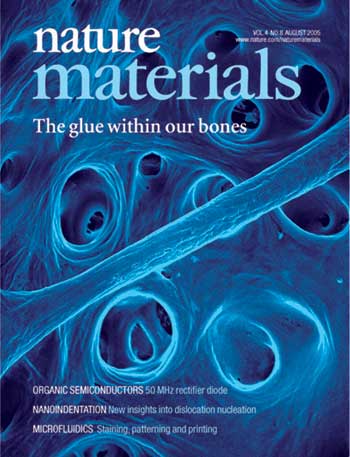
Using our AFM techniques we are able to explore the molecular origins of fracture resistance in mineralized tissues (primarily bone). Recently, we discovered that some noncollagenous bone proteins act as a molecular glue to resist bone fracture, using a fracture-resisting mechanism we have termed the sacrificial bond and hidden length mechanism. We are now working on characterizing this bone glue, among other research divisions on bone fracture resistance.
Our most current research involves development of The Osteoprobe II™ Bone Diagnostic Instrument. The instrument consists of a mechanically driven test probe enclosed in a reference probe (a hypodermic needle). The test probe is driven into the bone and creates microscopic indentations. After repeated cycling the indentation distance increase (the difference in indentation from the last and first cycle) is measured. This quantity has been shown to give the best representation of fracture risk. For more information please refer to the complete BDI webpage.
This site's design was created by Alex Lau (as Systems Administrator) and its content arranged and written by Simcha Frieda Udwin (as Lab Manager), under the direction of Paul Hansma. Almost all of the images on this site are taken from published or "in press" scientific papers created by our group members; others are from published scientific papers that we reference within the site. Please also note that all papers otherwise cited in this website are papers on which our group members were either primary or co-authors, unless otherwise noted.